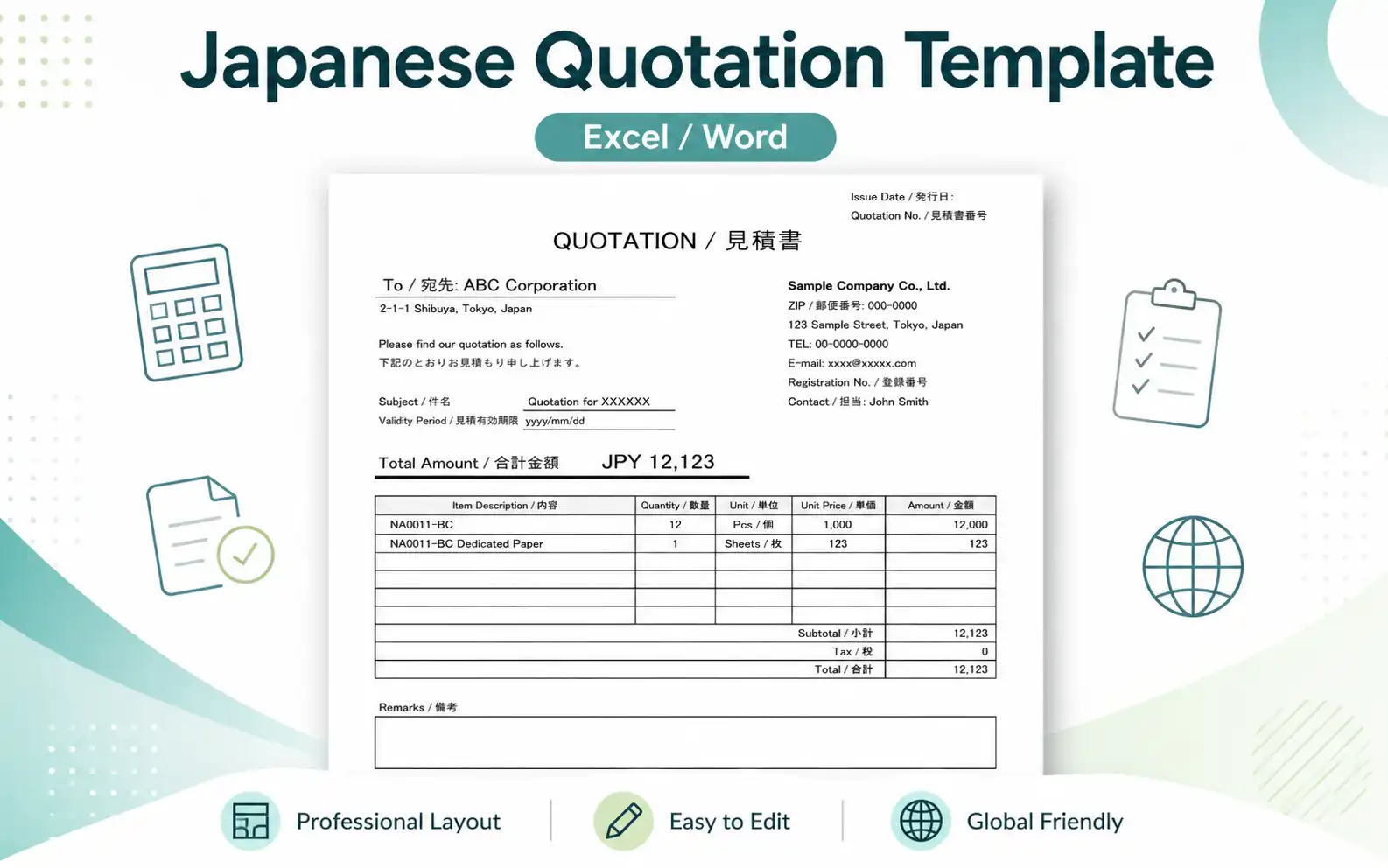
Download free Japanese quotation templates in Excel and Word. These templates are designed for overseas companies, freelancers, and professionals preparing quotations for Japanese business partners.
The templates use a clean Japanese-style layout, but the main labels are written in English. A bilingual English-Japanese version is also included, so the document can be easier for Japanese staff, purchasing teams, and managers to check.
When working with Japanese companies, a quotation can matter more than expected. It is often used for internal approval before an order is placed. A tidy format helps the person on the Japanese side share it with accounting, purchasing, or management without rewriting the details.
Free Japanese Quotation Templates
Choose the quotation template that fits your transaction. All templates are free to download. Most templates are available in both Excel and Word, while the tax calculation version is provided in Excel format.
Japanese Quotation Template 01
Basic quotation with optional tax field

This is a simple Japanese-style quotation template. It includes the basic fields needed for a quotation, such as quotation number, issue date, customer name, item description, quantity, unit price, amount, tax field, and total amount.
Japanese Quotation Template 02 with Consumption Tax
Excel quotation template with automatic 10% consumption tax calculation

This Excel template automatically calculates 10% consumption tax. It is useful when you want to show subtotal, consumption tax, and total amount clearly in a quotation for a Japanese business transaction.
Bilingual Japanese Quotation Template 03
English-Japanese quotation with optional tax field

This bilingual version includes both English and Japanese labels, such as “Issue Date / 発行日” and “Total Amount / 見積金額”. It is useful when the quotation is prepared by English-speaking staff but checked by Japanese staff or managers.
What Is a Japanese Quotation?
A Japanese quotation is a document used to show the proposed price of goods or services before an order is confirmed. In Japanese, this document is commonly called a “mitsumorisho.”
The basic purpose is similar to quotations used in other countries, but in Japan it is often treated as a fairly formal business document. The customer may use it to compare prices, request internal approval, or create a purchase order.
This is why the layout should be easy to read. The total amount, tax treatment, validity period, and payment or delivery conditions should be clear without needing to search through a long email thread.
If you need a Japanese-language format, you can also see our Japanese quotation templates.
Quotation or Estimate: Which Word Should You Use?
In English, “quotation” and “estimate” are sometimes used in a similar way. However, they do not feel exactly the same.
| Term | Meaning | Best for |
|---|---|---|
| Quotation | A price proposal with relatively clear conditions | Formal business documents sent to Japanese companies |
| Estimate | A rough or approximate cost | Early-stage discussions or rough budget planning |
For a Japanese “mitsumorisho,” “quotation” is usually the safer word. “Estimate” can sound a little more approximate, especially when the price has not yet been confirmed.
That said, some people may search for “Japanese estimate template,” so it is not wrong to mention both. For the actual document title, “Quotation” looks more formal and closer to how Japanese companies use a mitsumorisho.
Which Template Should You Use?
If you are not sure which template to choose, start with Template 01.
| Template | Best for | Tax field |
|---|---|---|
| Japanese Quotation Template 01 | General use and simple quotations | Manual / optional |
| Japanese Quotation Template 02 with Consumption Tax | Quotations where Japanese consumption tax should be shown | Excel only / automatic 10% calculation |
| Bilingual Japanese Quotation Template 03 | Quotations checked by both English and Japanese readers | Manual / optional |
For overseas companies, Template 01 is often the easiest starting point. It does not force a specific tax treatment, so you can enter “N/A,” “0,” or a tax amount manually depending on the transaction.
Template 02 is more specific. Use it when you need to show Japanese consumption tax at 10%.
Template 03 is useful when the document will be reviewed by both sides. The English labels make it easy for overseas staff to edit, while the Japanese labels make it easier for the Japanese side to check.
Common Items in a Japanese Quotation
A standard Japanese quotation usually includes the following items:
- Quotation number
- Issue date
- Customer name
- Issuer information
- Item description
- Quantity
- Unit
- Unit price
- Amount
- Subtotal
- Tax amount, if applicable
- Total amount
- Validity period
- Delivery date or service period
- Payment terms
- Notes
Not every quotation needs all of these items. For a small service or a simple product quote, a shorter format may be enough. Still, if the quotation will be used for internal approval, it is better to include the basic information clearly.
One common mistake is making the item description too vague. A line such as “Service fee” may be hard to approve internally. Something like “Website translation service,” “Monthly maintenance fee,” or “Product sample shipping cost” is usually easier to understand.
About Consumption Tax on Japanese Quotations
Japanese consumption tax does not apply to every international transaction. Whether tax should be shown depends on the transaction, the type of goods or services, and the business situation.
For that reason, the basic template does not automatically calculate tax. This is intentional.
If you are not sure about the tax treatment, it is better to enter “N/A” or confirm with the Japanese customer before sending the quotation. Adding 10% tax automatically may look convenient, but it can create confusion when the transaction is not subject to Japanese consumption tax.
If the seller is registered as a qualified invoice issuer in Japan, a registration number may also be included. For a quotation, this is usually optional. In the template, you can use the field “Registration No. (if applicable)” and leave it blank when it does not apply.
Recommended English Labels for a Japanese Quotation
The wording in a quotation should be simple. It does not need to be overly formal, but it should be clear enough for the customer to understand quickly.
| English label | Japanese meaning |
|---|---|
| Quotation No. | 見積書番号 |
| Issue Date | 発行日 |
| To | 宛先 |
| From | 発行者 |
| Item Description | 品目・内容 |
| Quantity | 数量 |
| Unit | 単位 |
| Unit Price | 単価 |
| Amount | 金額 |
| Subtotal | 小計 |
| Tax | 税額 |
| Total Amount | 見積金額 |
| Validity | 有効期限 |
| Payment Terms | 支払条件 |
| Notes | 備考 |
For the customer field, “To” is usually better than “Bill To.” “Bill To” is natural on an invoice, but it can feel a little too early for a quotation because no billing has happened yet.
For the amount shown at the top of the document, “Total Amount” is clean and natural. “Estimated Amount” may sound like a rough estimate, and “Quotation Amount” can feel a little direct.
Japanese Business Customs to Keep in Mind
Japanese companies often use quotations for internal approval. The person who receives your quotation may not be the final decision maker. It may be forwarded to a manager, purchasing department, or accounting team.
Because of that, the document should stand on its own. Even if the price was already discussed by email, the quotation should still show the important points clearly.
The official company name is another small but important detail. In Japan, company names are often written formally on business documents. If you know the customer’s official company name, use that instead of a shortened name.
This sounds minor, but it does make a difference. A quotation that looks tidy and official is easier for the Japanese side to pass around internally.
How to Use the Template
- Download the Excel or Word file.
- Enter your company information.
- Add the customer name and quotation details.
- Fill in the item description, quantity, unit, unit price, and amount.
- Check the subtotal, tax field, and total amount.
- Add the validity period, delivery conditions, and payment terms.
- Save the file as PDF before sending it to the customer.
Before sending the quotation, check the total amount, tax treatment, and validity period one more time. These are the details that most often lead to follow-up questions.
Notes About Quotation Validity
Japanese quotations often include a validity period. For example:
This quotation is valid for 30 days from the issue date.
You can also write:
Valid until YYYY/MM/DD.
This is especially useful when prices may change because of exchange rates, shipping costs, material costs, or project conditions.
For overseas companies, I would avoid leaving the validity period blank unless the price is very stable. It is a small line, but it can prevent an awkward conversation later.
Quotation, Purchase Order, and Invoice
A quotation is usually sent before the order is confirmed. It shows the proposed price and conditions.
A purchase order is usually issued by the buyer after they accept the quotation. It shows that the buyer wants to place an order.
An invoice is sent when payment needs to be requested. Depending on the transaction, it may be issued after delivery, after completion, or after the order is confirmed.
| Document | Typical timing | Main purpose |
|---|---|---|
| Quotation | Before the order is confirmed | To propose prices and conditions |
| Purchase Order | After the customer accepts the quotation | To place an order |
| Invoice | After delivery, completion, or order confirmation | To request payment |
The order may vary depending on the company, but in many Japanese business situations, the flow is:
Typical document flow
Step 1
›
Step 2
›
Step 3
›
Step 4
›
Step 5
Understanding this flow helps you choose the right document at the right time.
FAQ
Can I use this quotation template for a Japanese company?
Yes. These templates are designed for quotations sent to Japanese companies. They use a clean Japanese-style layout with English labels, so overseas users can edit them easily.
Should I use “Quotation” or “Estimate”?
For a Japanese mitsumorisho, “Quotation” is usually better. “Estimate” can sound more approximate, while “Quotation” feels more suitable for a formal price proposal.
Should I include consumption tax?
It depends on the transaction. If you are not sure whether Japanese consumption tax applies, use the optional tax version or confirm with the Japanese customer before sending the quotation.
What does Registration No. mean?
In this template, “Registration No.” refers to the Japanese qualified invoice issuer registration number. It is not required for most quotations. If it does not apply, leave this field blank.
Can I send the quotation as a PDF?
Yes. After editing the Excel or Word file, it is usually better to export it as a PDF before sending it. This helps prevent layout changes and makes the quotation easier to file or share internally.
Can I edit the bilingual Japanese text?
Yes. You can edit or remove the Japanese text if it is not needed. The English labels are the main labels, and the Japanese labels are included as support for Japanese readers.
Related Resources
If you need more detailed information about Japanese consumption tax, invoice rules, or business customs, the following English resources may be helpful.
- National Tax Agency: Outline of the Invoice System
- JETRO: Setting Up Business in Japan
- JETRO: Communicating with Japanese in Business
- Japan Intercultural Consulting: Japanese Business Etiquette Guide
Summary
These Japanese quotation templates are useful when you need a clean price proposal for business with a Japanese company.
For most overseas users, Template 01 is the easiest starting point. It has a Japanese-style structure, but the tax field is optional, so it does not force a tax treatment that may not apply.
If you need to show 10% Japanese consumption tax, use Template 02. If both English and Japanese readers will check the document, Template 03 is the most practical choice.