
A checklist helps you make sure important steps are not missed. It can be used for office work, inspections, daily routines, event preparation, handover tasks, and other jobs that need the same checks each time.
These free checklist templates for Excel are simple and easy to edit. You can change the item names, add columns, adjust the layout, or print the sheet for use at a desk, warehouse, shop, or office.
When working with Japanese companies, checklists are often useful because work procedures may be reviewed by several people. A clear checklist makes it easier to confirm who checked what, and it helps avoid small mistakes before they become annoying follow-up work.
One thing to watch out for: do not make the checklist too detailed at the beginning. If every tiny action is written down, people may stop using it after a few days. Start with the steps that really matter, then add more items later if needed.
See the following article for a to-do list template, which is similar but used in a slightly different way.
To Do List Templates | Free Excel
Free Checklist Templates for Excel
You can download free Excel checklist templates below. These templates are useful for work procedures, office checks, inspection lists, preparation tasks, and simple daily confirmation sheets.
Click the thumbnail image to see a larger preview. Use the “Download” button to download the Excel file.
The templates are intentionally simple, so you can edit them without fighting with complicated formulas or settings. Add your own check items, change the headings, or remove columns that you do not need.
Simple Checklist Templates
These are basic checklist templates that can be used for many kinds of work. They are suitable for office tasks, cleaning checks, equipment checks, daily routines, and small project procedures.


A4 Horizontal Checklist Template
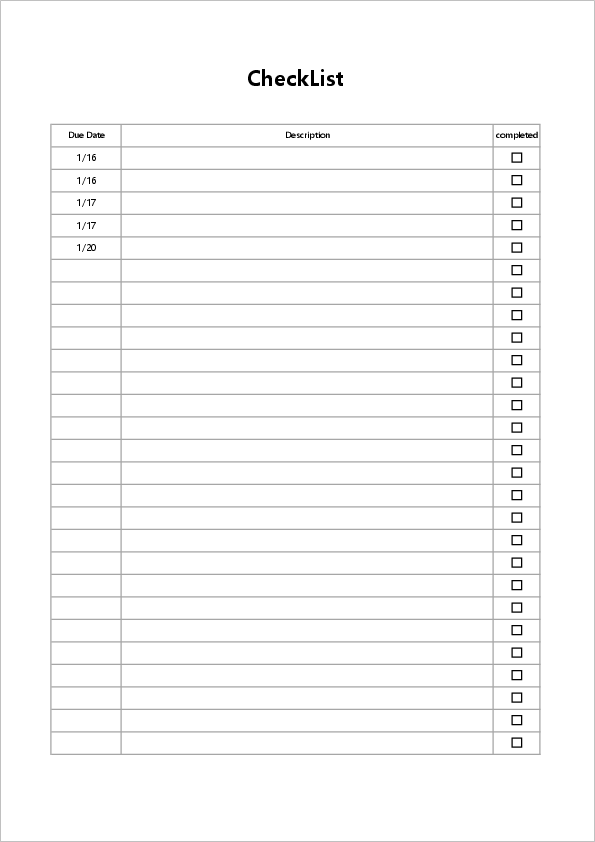
This is an A4 horizontal checklist template with a clean green layout. Because each line is lightly colored, it is easy to follow the list across the page.
This type works well when you want to add more columns, such as person in charge, due date, confirmation result, or remarks. It is also easier to use in meetings because several people can look at the same row without losing their place.

Common Ways to Use a Checklist
A checklist can be used in many everyday business situations. For example, it can help with opening and closing tasks at a shop, checking documents before submission, preparing items before a meeting, confirming delivery items, or reviewing steps before sending data to a client.
In Japanese workplaces, checklists are sometimes used for double-checking. One person completes the work, and another person confirms it. This may feel a little formal at first, but it reduces small mistakes, especially for documents, payments, shipments, and customer information.
For new staff, a checklist is also helpful because it works like a quiet guide. You do not have to ask the same question every time, and the manager does not have to explain the same steps again and again. That alone can save a surprising amount of time.
Tips for Making a Checklist Easy to Use
A checklist should be simple enough to use without thinking too much. If it becomes too long, people may skip it when they are busy.
Here are a few practical tips:
- Write each item as one clear action.
- Put the items in the actual order of work.
- Add a date or person-in-charge column if the list will be reviewed later.
- Leave a remarks column for small notes or exceptions.
- Do not add too many items at first. Start small and improve it later.
A good checklist does not have to look perfect. In real work, the best one is usually the list that people actually keep using.
The Difference Between a Checklist and a To-Do List
A checklist and a to-do list look similar, but they are used in slightly different ways.
A checklist is mainly used to confirm steps, conditions, or required items. It is useful when the same process is repeated many times, such as document checks, inspection work, closing tasks, or preparation work.
A to-do list is more about managing tasks that need to be done. It is often used for personal work management, daily schedules, project tasks, or reminders.
- Checklist: Used to confirm steps, items, or conditions.
- To-do list: Used to manage tasks and actions to be completed.
For example, “send quotation to client” is a to-do item. But “check client name, quotation number, amount, tax, and validity date before sending” is better as a checklist.
You can learn more about the to-do list template in the following article.