Managing cash may look simple, but small cash payments can quickly become unclear if they are not recorded properly. A cash book helps you track cash received, cash paid out, and the remaining cash balance.
This page provides free Excel cash book templates that can be used for Japanese-style cash management. They are useful for petty cash, office expenses, transportation costs, postage, small reimbursements, and other cash-based payments.
In Japanese business practice, receipts and small cash expenses are often checked carefully at month-end. Even if the amount is small, the date, purpose, payee, and receipt should be easy to confirm. Otherwise, accounting staff or managers may need to ask questions later. That small back-and-forth can be surprisingly annoying.
These templates are simple, but that is the point. For small businesses, sole proprietors, branch offices, or administrative staff who need a basic cash record, Excel is often enough.
Free Japanese Cash Book Templates for Excel
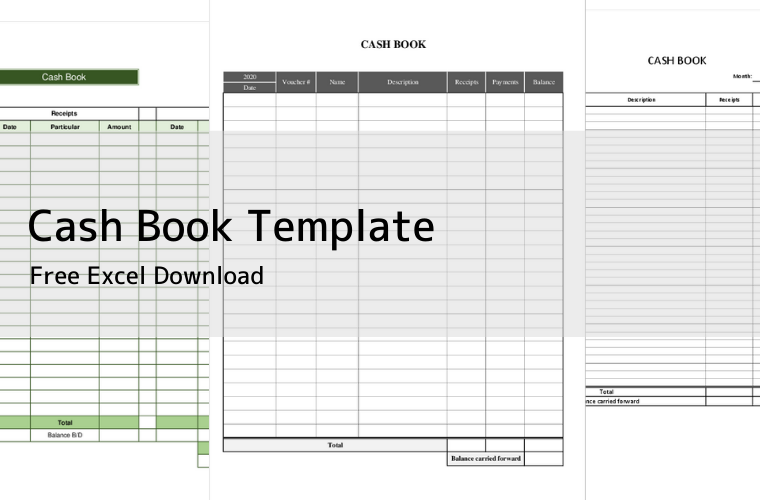
You can download free Japanese cash book templates below. These templates are designed for recording daily cash receipts, cash payments, petty cash, and cash balances.
Click the thumbnail image to see a larger preview. Use the “Go to download page” button below each image to open the download page.
What Is a Cash Book?
A cash book is a ledger used to record cash transactions. It shows how much cash came in, how much cash went out, and how much cash should remain on hand.
In many Japanese companies, large payments are usually made by bank transfer. Still, cash may be used for small office expenses, transportation, postage, supplies, parking fees, or employee reimbursements. For these small payments, a cash book is useful because it keeps the record simple and visible.
- Date
- Description or purpose
- Cash received
- Cash paid out
- Balance
- Payee or payer
- Receipt or voucher number
- Person in charge
- Notes
One common mistake is entering cash expenses only at the end of the week or month. It feels faster at first, but later you may not remember what the payment was for. I have seen this happen with small transportation costs and office supply purchases. The receipt is there, but no one is completely sure which project or department it belongs to.
It is much easier to record the transaction while the receipt is still on your desk.
Cash Book Templates
Cash Book Template 01


Cash Book Template 03

How to Use a Japanese Cash Book in Excel
First, download the cash book template that is easiest for you to read. Then open it in Excel and enter the opening cash balance.
After that, record each cash transaction one by one. When cash is received, enter it in the income or receipt column. When cash is paid out for office supplies, transportation, postage, or reimbursement, enter it in the payment column.
For Japanese-style office use, it is also helpful to keep receipts in the same order as the cash book entries. This is a small habit, but it makes month-end checking much easier. If someone asks, “What was this payment for?” you can find the receipt quickly without searching through a pile of paper.
- Enter the opening cash balance.
- Record each cash receipt or payment on one row.
- Write the purpose clearly.
- Attach or store the receipt in order.
- Check whether the actual cash matches the book balance.
In Japan, it is usually better to avoid vague descriptions such as “miscellaneous” or “other expense.” They may be accepted for a quick internal note, but they are not very helpful when someone checks the record later. A description such as “postage,” “train fare,” “office supplies,” or “client meeting parking fee” is much easier to understand.
Tips for Managing Petty Cash
Petty cash is convenient, but it can easily become unclear if the rules are loose. Before using a cash book, decide who manages the cash, when the balance is checked, and where receipts are stored.
- Record cash transactions on the same day whenever possible.
- Keep receipts and vouchers together with the cash book.
- Check the actual cash balance regularly.
- Write the purpose of each payment clearly.
- Use one row for one transaction.
- Avoid vague descriptions such as “miscellaneous” when possible.
In a Japanese office, petty cash may be handled by accounting staff, general affairs staff, a department assistant, or the business owner. The person in charge may be different depending on the size of the company, but the basic rule is the same: the actual cash on hand should match the balance in the cash book.
This is where people often get stuck. The Excel sheet looks correct, but the cash in the drawer is short by a small amount. Then someone has to check receipts one by one, usually near the end of the month when everyone is already busy. It is not a big problem, but it wastes time.
Recording entries carefully from the beginning is much less stressful.
Japanese Business Practice: Receipts Matter
When doing business in Japan, receipts are important even for small payments. A cash book entry without a receipt may still be recorded internally, but it can require extra explanation.
For example, if an employee pays cash for postage, office supplies, or local transportation, the accounting person may check whether the receipt or voucher is attached. If the receipt is missing, it helps to write a short note in the cash book, such as the reason for the payment and who approved it.
This may feel a little detailed, especially for small amounts. But in practice, clean records make month-end closing much smoother.
- Receipt attached
- No receipt available
- Approved by manager
- Employee reimbursement
- Paid for office use
For a new employee or a person handling petty cash for the first time, this kind of small note is helpful. It reduces questions later and makes the record easier for another person to understand.
When Excel Is Enough, and When Accounting Software Is Better
Excel is useful when the number of cash transactions is small and one person manages the cash book. It is easy to edit, print, and keep as a simple internal record.
However, if your business has many transactions, multiple people entering data, or needs detailed accounting reports, accounting software may be more suitable. Excel is a good starting point, but it should not become a place where important accounting information is hard to check.
If you plan to move to accounting software later, keep the Excel cash book simple and clean. Use one row for one transaction, avoid unnecessary merged cells, and use consistent item names. This makes it easier to review or transfer the data later.
Summary
A Japanese cash book is a simple but useful tool for managing cash in a business. By recording daily cash receipts and payments, you can check the cash balance and reduce mistakes at month-end.
For small businesses, sole proprietors, and office administrators, an Excel cash book template is often enough to start. Download a template, enter transactions regularly, and keep receipts together with the records.
Cash management is not the most exciting office task, to be honest. But when the actual cash and the Excel balance match cleanly at the end of the month, it feels surprisingly good. And more importantly, no one has to dig through receipts in a hurry.