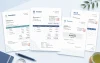
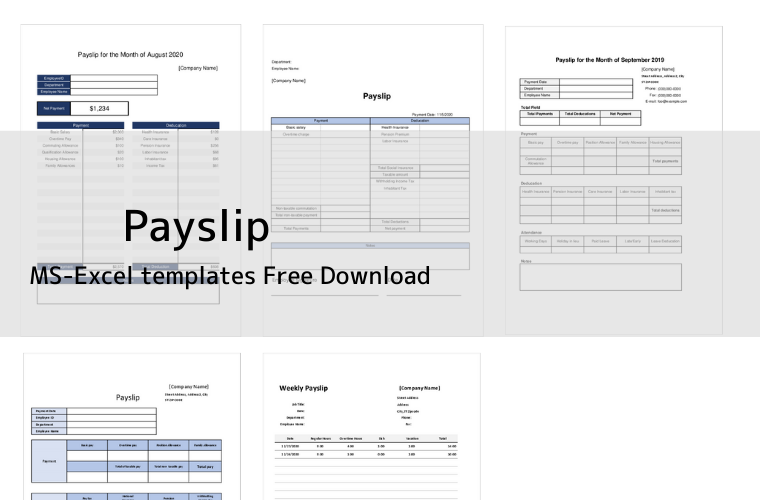
Japanese companies usually issue a payslip every month when salary is paid. In many cases, it shows basic salary, allowances, overtime pay, social insurance, income tax, resident tax, and the final net pay.
For companies using payroll software, payslips are often generated automatically. But for small offices, branch offices, or companies that only need a simple salary record, an Excel template can still be useful.
This page provides free Japanese-style payslip templates in Excel format. They are simple, editable, and designed for cases where you need a clean salary slip that looks familiar in Japan.


What Is a Japanese Payslip?
A Japanese payslip is a salary statement given to an employee for a specific pay period. It usually shows how the salary was calculated and what was deducted before the final payment.
The layout is often quite compact. A typical Japanese-style payslip separates the information into three parts: payment items, deduction items, and the final net pay. This is a bit different from some overseas formats, where the payslip may be more like a letter or a detailed payroll report.
In Japan, employees often check the net pay first, then look at items such as overtime pay, commuting allowance, income tax, resident tax, and social insurance. So when making a template, it is better to keep these items easy to find.
Main Items Included in a Japanese Payslip
A Japanese payslip normally includes the following items.
| Item | Example | Notes |
|---|---|---|
| Employee Name | John Smith | Name of the employee receiving the salary. |
| Pay Period | 2026/06 | The month or period covered by the payslip. |
| Payment Date | 2026/06/25 | The actual salary payment date. |
| Basic Salary | JPY 250,000 | The base monthly salary before allowances and deductions. |
| Allowances | Commuting Allowance, Position Allowance | Common in Japan. Commuting allowance is often shown separately. |
| Overtime Pay | JPY 20,000 | Used when overtime is paid separately. |
| Gross Pay | JPY 280,000 | Total payment amount before deductions. |
| Social Insurance | Health Insurance, Pension Insurance | Often one of the largest deduction sections. |
| Employment Insurance | JPY 1,500 | Usually listed as a separate deduction. |
| Income Tax | JPY 5,000 | Withholding income tax. |
| Resident Tax | JPY 12,000 | In Japan, this may appear on monthly payslips. |
| Net Pay | JPY 240,000 | The final amount paid to the employee. |
Tips for Japanese-Style Payslips
When preparing payslips for Japanese employees or a Japanese branch office, the most important point is not only the design. The item names also matter.
For example, “tax” alone may be too vague. In Japan, it is usually clearer to separate income tax and resident tax. The same applies to insurance deductions. Health insurance, pension insurance, and employment insurance are often checked one by one, especially when an employee asks why the take-home pay changed.
Another point is the salary month. Some companies pay the salary for June on June 25, while others pay it in July. This can be confusing when the person preparing the document is not used to Japanese payroll timing. I would keep both “Pay Period” and “Payment Date” in the template. It avoids small questions later.
Common Mistakes When Using a Payslip Template
A common mistake is treating the payslip as only a payment receipt. It is not quite the same.
A payslip should show the breakdown: what was paid, what was deducted, and what remains as net pay. If the template only shows the final salary amount, employees may come back with questions, especially when social insurance or resident tax changes.
Another easy mistake is mixing taxable and non-taxable allowances. Commuting allowance, for example, may need different handling depending on the situation. The template can show the item, but the calculation itself should be checked carefully.
When I make a simple payslip in Excel, the part that usually takes more time is not the design. It is deciding which deduction lines to include without making the sheet too crowded. A clean template is useful, but too few lines can make it harder to use in real payroll work.
Who Can Use These Templates?
These templates are suitable for small companies, startups, local offices, and administrative staff who need a simple Japanese-style payslip format.
They may be especially useful when:
- You need a quick Excel payslip format for a small team
- You want a clean Japanese-style salary slip
- You need to explain salary details to an employee in a simple way
- You manage payroll records manually or semi-manually
- You want to customize item names for your company
For a new HR or accounting staff member, it may be easier to start with a template rather than creating a payslip from a blank spreadsheet. You can adjust the item names, add company information, and change the deduction rows as needed.
How to Use the Excel Payslip Template
Download the Excel file and open it on your computer. Then enter the employee name, pay period, payment date, salary items, deduction items, and net pay.
Before sending the payslip to an employee, check the calculation carefully. In particular, social insurance, income tax, and resident tax should match your actual payroll data. If the numbers are copied from another payroll sheet, it is a good idea to check the final net pay once more before issuing the payslip.
For filing, many Japanese companies keep payslips in a monthly order. Using a file name such as “payslip_2026_06_employee-name.xlsx” makes it easier to find later.
Summary
A Japanese payslip template should be simple, but it should still show the important breakdown: earnings, allowances, deductions, and net pay.
If you work with Japanese employees or a Japanese office, using familiar item names such as income tax, resident tax, health insurance, pension insurance, and employment insurance makes the payslip easier to understand.
You can download the free Excel templates above and edit them to match your company’s salary format.